Donatello Art What Was the Purpose of Catholic Reformation
| Donatello | |
|---|---|
 (Sixteenth-century portrait) | |
| Born | Donato di Niccolò di Betto Bardi c. 1386 Republic of Florence |
| Died | 13 December 1466(1466-12-13) (aged 79–lxxx) Democracy of Florence |
| Nationality | Florentine |
| Didactics | Lorenzo Ghiberti |
| Known for | Sculpture |
| Notable work | Saint George, David, Equestrian Monument of Gattamelata |
| Motion | Early Renaissance |
Donato di Niccolò di Betto Bardi (c. 1386 – 13 December 1466), ameliorate known as Donatello ([one] Italian: [donaˈtɛllo]), was a Florentine sculptor of the Renaissance period. Built-in in Florence, he studied classical sculpture and used this to develop a complete Renaissance mode in sculpture. He spent time in other cities, and while at that place he worked on commissions and taught others; his periods in Rome, Padua, and Siena introduced to other parts of Italian republic his techniques, adult in the course of a long and productive career. Financed past Cosimo de' Medici, Donatello's David was the beginning freestanding nude male person sculpture since antiquity.
He worked with stone, bronze, woods, clay, stucco, and wax, and had several assistants, with iv perhaps being a typical number. Although his best-known works mostly were statues in the circular, he developed a new, very shallow, blazon of bas-relief for small-scale works, and a skilful deal of his output was larger architectural reliefs.
Early life [edit]

Donatello was the son of Niccolò di Betto Bardi, who was a fellow member of the Florentine Arte della Lana. He was born in Florence, probably in the twelvemonth 1386. Donatello was educated in the firm of the Martelli family.[2] He apparently received his early artistic grooming in a goldsmith'south workshop,[ commendation needed ] and then worked briefly in the studio of Lorenzo Ghiberti.[3]
In Pistoia in 1401, Donatello met the older Filippo Brunelleschi. They likely went to Rome together around 1430, staying until the next year, to study the architectural ruins. Brunelleschi informally tutored Donatello in goldsmithing and sculpture.[iv] Brunelleschi's buildings and Donatello'south sculptures are both considered supreme expressions of the spirit of this era in compages and sculpture, and they exercised a stiff influence upon the artists of the age.
Work in Florence [edit]


Donatello'south David caput and shoulders front correct
In Florence, Donatello assisted Lorenzo Ghiberti with the statues of prophets for the north door of the Baptistery of Florence Cathedral, for which he received payment in November 1406 and early 1408. In 1409–1411 he executed the jumbo seated figure of Saint John the Evangelist, which occupied a niche of the old cathedral façade until 1588, and now is placed in the Museo dell' Opera del Duomo. This piece of work marks a decisive pace forward from late Gothic Mannerism in the search for naturalism and the rendering of human feelings.[v] The confront, the shoulders, and the bust are still arcadian, while the hands and the fold of fabric over the legs are more realistic.
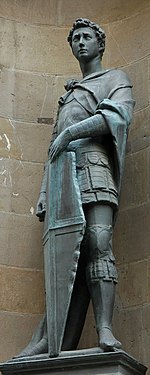
In 1411–1413, Donatello worked on a statue of St. Mark for the lodge church of Orsanmichele. In 1417 he completed the Saint George for the Confraternity of the Cuirass-makers. From 1423 is the Saint Louis of Toulouse for the Orsanmichele, now in the Museum of the Basilica di Santa Croce. Donatello as well had sculpted the classical frame for this work, which remains, while the statue was moved in 1460 and replaced by the Incredulity of Saint Thomas by Verrocchio.
Between 1415 and 1426, Donatello created five statues for the campanile of Santa Maria del Fiore in Florence, also known as the Duomo. These works are the Beardless Prophet; Bearded Prophet (both from 1415); the Sacrifice of Isaac (1421); Habbakuk (1423–25); and Jeremiah (1423–26); which follow the classical models for orators and are characterized by stiff portrait details. From the 1420'south is the Pazzi Madonna relief in Berlin. In 1425, he executed the notable Crucifix for Santa Croce; this work portrays Christ in a moment of the agony, eyes and mouth partially opened, the body contracted in an ungraceful posture.
From 1425 to 1427, Donatello collaborated with Michelozzo on the funerary monument of the Antipope John XXIII for the Battistero in Florence. Donatello fabricated the recumbent bronze figure of the deceased, nether a shell. In 1427, he completed in Pisa a marble relief for the funerary monument of Primal Rainaldo Brancacci at the church of Sant'Angelo a Nilo in Naples. In the aforementioned period, he executed the relief of The Feast of Herod (c. 1427) and the statues of Organized religion and Hope for the Baptistery of San Giovanni in Siena. The Feast of Herod is by and large in stiacciato (a very depression bas-relief), with the foreground figures done in bas-relief, and is one of the outset examples of one-indicate perspective in sculpture.
Donatello also restored antique sculptures for the Palazzo Medici.[6]
Bronze David [edit]
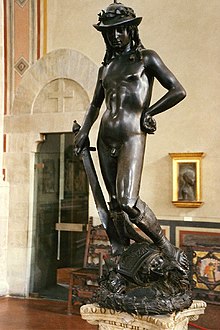
Donatello's statuary David, at present in the Bargello museum, is Donatello's virtually famous work, and the first known free-continuing nude statue produced since artifact. Conceived fully in the circular, independent of any architectural surroundings, and largely representing an allegory of the borough virtues triumphing over brutality and irrationality, it is arguably the start major work of Renaissance sculpture. It was commissioned past Cosimo de' Medici for the courtyard of his Palazzo Medici, but its date remains the subject of debate. It is most often dated to the 1440s, but dates as later as the 1460s have support from some scholars. It is not to be confused with his stone David, with clothes, of nigh 1408–09.
Some take perceived the David as having homoerotic qualities and have argued that this reflected the artist'southward own orientation.[7] The historian Paul Strathern makes the claim that Donatello made no secret of his homosexuality, and that his behaviour was tolerated by his friends.[8] The chief evidence comes from anecdotes by Angelo Poliziano in his "Detti piacevoli ", where he writes about Donatello surrounding himself with "handsome administration" and chasing in search of one that had fled his workshop.[9] This may non exist surprising in the context of attitudes prevailing in the 15th- and 16th-century Florentine republic. Still, little detail is known with certainty about his private life, and no mention of his sexuality has been constitute in the Florentine archives (in terms of denunciations)[10] albeit which during this period are incomplete.[11]
Rome, Prato, and Venice [edit]
When Cosimo was exiled from Florence, Donatello went to Rome, remaining until 1433. The ii works that testify to his presence in this city, the Tomb of Giovanni Crivelli at Santa Maria in Aracoeli, and the Ciborium at St. Peter'due south Basilica, bear a strong stamp of classical influence.
Donatello's return to Florence almost coincided with Cosimo'southward. In May 1434, he signed a contract for the marble pulpit on the facade of Prato cathedral, the last projection executed in collaboration with Michelozzo. This work, a passionate, pagan, rhythmically conceived bacchanalian dance of half-nude putti, was the forerunner of the great Cantoria, or singing tribune, at the Duomo in Florence on which Donatello worked intermittently from 1433 to 1440 and was inspired by ancient sarcophagi and Byzantine ivory chests. In 1435, he executed the Annunciation for the Cavalcanti altar in Santa Croce, inspired past 14th-century iconography, and in 1437–1443, he worked in the Former Sacristy of the San Lorenzo in Florence, on ii doors and lunettes portraying saints, likewise as eight stucco tondoes. From 1438 is the wooden statue of St. John the Baptist for Santa Maria Gloriosa dei Frari in Venice. Around 1440, he executed a bust of a Young Human with a Cameo now in the Bargello, the first instance of a lay bust portrait since the classical era.
In Padua [edit]
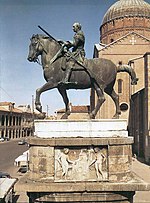
In 1443, Donatello was called to Padua by the heirs of the famous condottiero Erasmo da Narni (better known every bit the Gattamelata, or "Honey-Cat"), who had died that twelvemonth. Completed in 1450 and placed in the square facing the Basilica of St. Anthony, his Equestrian Monument of Gattamelata was the beginning example of such a monument since ancient times. (Other equestrian statues, from the 14th century, had non been executed in bronze and had been placed over tombs rather than erected independently, in a public place.) This work became the prototype for other equestrian monuments executed in Italy and Europe in the following centuries.
For the Basilica of St. Anthony, Donatello created, most famously, the bronze Crucifix of 1444–47 and additional statues for the choir, including a Madonna with Child and six saints, constituting a Holy Conversation, which is no longer visible since the renovation by Camillo Boito in 1895. The Madonna with Child portrays the Child existence displayed to the faithful, on a throne flanked by two sphinxes, allegorical figures of knowledge. On the throne's back is a relief of Adam and Eve. During this menstruum—1446–fifty—Donatello also executed iv extremely of import reliefs with scenes from the life of St. Anthony for the high altar.
Main works [edit]
- St. Mark (1411–1413), Orsanmichele, Florence
- St. George Tabernacle (c. 1415–1417) – Museo Nazionale del Bargello, Florence
- Zuccone (1423–1425) – Museo dell'Opera del Duomo, Florence
- The Feast of Herod (c. 1425) – Baptismal font, Baptistry of San Giovanni, Siena
- David (c. 1425–1430) – Museo Nazionale del Bargello, Florence
- Madonna of the Clouds (c. 1425–1435) – Museum of Fine Arts, Boston
- Madonna and Child (c. 1440) – Musée du Louvre, Paris
- Equestrian Monument of Gattamelata (1445–1450) – Piazza del Santo, Padua
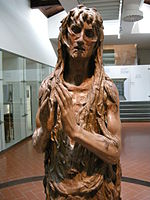
- Magdalene Penitent (c. 1455) – Museo dell'Opera del Duomo, Florence
- Judith and Holofernes (1455–1460) – Palazzo Vecchio, Florence
- Virgin and Child with Four Angels or Chellini Madonna (1456), Victoria and Albert Museum


Il Cristo di Sant'Angelo di Legnaia
2020 discovery [edit]
In 2020 art historian Gianluca Amato, as office of his research on wooden crucifixes crafted betwixt the late thirteenth and the beginning half of the sixteenth century for his doctoral thesis at the Academy of Naples Federico 2, discovered that the crucifix of the church of Sant'Angelo a Legnaia was sculpted by Donatello.
This discovery has been evaluated historically, considering that the work belonged to the Compagnia di Sant'Agostino that was based in the oratory side by side to the mother church of Sant'Angelo a Legnaia. Silvia Bensì performed restoration work on the crucifix.[12] [xiii] [fourteen] [15]
In popular civilization [edit]
Donatello is portrayed by Ben Starr in the 2016 television series Medici: Masters of Florence.[xvi]
The fictional crimefighter Donatello, one of the Teenage Mutant Ninja Turtles, is named after him.
Donatello is portrayed past Rhett McLaughlin in the 2014 Epic Rap Battles of History video Artists versus Teenage Mutant Ninja Turtles, in which he appears working on Gattamelata and is mocked for being less famous than other Renaissance artists. [17]
The Donatello Multi-Purpose Logistics Module (MPLM) built by the Italian Space Agency, was one of 3 MPLMs operated by NASA to transfer supplies and equipment to and from the International Space Station. The others were named Leonardo and Raffaello.
References [edit]
- ^ Wells, John (3 April 2008). Longman Pronunciation Lexicon (3rd ed.). Pearson Longman. ISBN978-1-4058-8118-0.
- ^ Rubin, Patricia Lee. Giorgio Vasari: Art and History. p. 350. ISBN9780300049091.
- ^ Walker, Paul Robert (2003). The Feud That Sparked the Renaissance. New York: William Morrow. pp. 11. ISBN9780061743559.
- ^ Walker, Paul Robert (2003). The Feud That Sparked the Renaissance. New York: William Morrow. pp. 26, 30, 34. ISBN9780061743559.
- ^ Janson, The Sculpture of Donatello, Princeton, 1963.
- ^ Hesson, Robert (28 July 2019). "Collections and restoration of antiquities – Ancient Monuments". Northern Architecture . Retrieved 21 September 2020.
- ^ H.W. Janson, The Sculpture of Donatello, Princeton, 1957, 2, 77–86; Laurie Schneider, "Donatello's Bronze David," The Fine art Bulletin, 55 (1973) 213–216.
- ^ Paul Strathern, The Medici: Godfathers of the Renaissance, London, 2003
- ^ Michael Rocke, Forbidden Friendships: Homosexuality and Male Culture in Renaissance Florence [ page needed ]
- ^ J. Poeschke, Donatello and His World (1994)
- ^ Louis Crompton, Homosexuality and Civilization, Harvard Printing, 2003, p. 264.
- ^ Mugnaini, Olga (6 March 2020). "'Quel crocifisso ligneo è di Donatello', la sensazionale scoperta a Firenze". La Nazione (in Italian). Retrieved 26 March 2020.
- ^ "Studioso scopre Crocifisso inedito di Donatello". Adnkronos . Retrieved 26 March 2020.
- ^ Salzano, Marco Pipolo & Guido. "E". QAeditoria.it – QA turismo cultura & arte . Retrieved 26 March 2020.
- ^ "Crocifisso di Donatello nella chiesa di Legnaia, la storia". Isolotto Legnaia Firenze (in Italian). half dozen March 2020. Retrieved 26 March 2020.
- ^ "Medici: Masters of Florence". Internet Movie Database . Retrieved 24 December 2016.
- ^ ERB. "Artists vs TMNT. Epic Rap Battles of History". Retrieved thirteen Feb 2022.
This article incorporates text from a publication now in the public domain:Chisholm, Hugh, ed. (1911). "Donatello". Encyclopædia Britannica. Vol. viii (11th ed.). Cambridge Academy Printing. pp. 406–408.

Further reading [edit]
- Avery, Charles, Donatello: An Introduction, New York, 1994.
- Avery, Charles, Donatello. Catalogo completo delle opere, Firenze 1991.
- Avery, Charles and McHam, Sarah Blake. "Donatello". Grove Fine art Online. Oxford Art Online. Oxford University Press. (subscription required)
- Bennett, Bonnie A. and Wilkins, David G., Donatello, Oxford 1984.
- Coonin, A. Victor, Donatello and the Dawn of Renaissance Fine art, Reaktion Books, London, 2019.
- Greenhalgh, Michael, Donatello and His Sources, Holmes & Meier Pub., 1982.
- Hartt, Frederick and Wilkins, David 1000., History of Italian Renaissance Art (7th ed.), Pearson, 2010.
- Janson, Horst West., The Sculpture of Donatello, Princeton Academy Printing, 1957.
- Leach, Patricia Ann, Images of Political Triumph: Donatello's Iconography of Heroes, Princeton University Press, 1984.
- Olson, Roberta J.M., Italian Renaissance Sculpture, 1992, Thames & Hudson (World of Art), ISBN 978-0500202531
- Randolph, Adrian W.B., Engaging Symbols: Gender, Politics, and Public Art in Fifteenth-Century Florence. Yale University Press, 2002.
- Vasari, Giorgio, Le vite de' più eccellenti pittori, scultori due east architettori Lives of the Most Fantabulous Painters, Sculptors, and Architects, Firenze 1568, edizione a cura di R. Bettarini e P. Barocchi, Firenze, 1971.
- Wilson, Carolyn C., Renaissance Small Bronze Sculpture and Associated Decorative Arts, 1983, National Gallery of Art (Washington), ISBN 0894680676
External links [edit]
 | Wikimedia Eatables has media related to Donatello. |
- Donatello: Biography, style, and artworks
- Donatello: Art in Tuscany
- Donatello at The Metropolitan Museum of Fine art
- Donatello: Photograph Gallery
- Donatello, past David Lindsay, 27th Earl of Crawford, from Projection Gutenberg
- The Chellini Madonna Sculpture. Victoria and Albert Museum
Source: https://en.wikipedia.org/wiki/Donatello
0 Response to "Donatello Art What Was the Purpose of Catholic Reformation"
Post a Comment