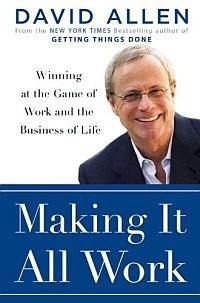
Book Review: David Allen's "Making It All Work" (Part 3 of 3)

The second major theme in David Allen's Making Information technology All Work is "perspective". (The showtime major theme, "control", is discussed in function ii of this review.) This function of the book expands profoundly on the "Horizons of Focus" to which Allen commits just 9 pages in the original Getting Things Washed.
Getting perspective means two things for Allen. First, and less importantly, it ways consciously sorting your priorities before you ever undertake any work, then that you're not wondering what you should be doing in the heat of the moment – yous're just doing.
Second, getting perspective is about answering the question that has become something of a mantra for Allen: "Is what I'thousand doing right now the most important affair I could be doing in my life?" The power of this question – and the power of asking this question nearly everything we do – should be credible. It is well-nigh the choices we must make if we are to alive a meaningful life.
Allen uses the metaphor of an plane ascending from the rail to its cruising altitude at 50,000 anxiety to explain the various Horizons of Focus. On the runway, life appears… well, as large as life. Problems come at us and demand solving, tasks have equally long equally they accept to finish, we are (hopefully) fully engaged in the busy-piece of work of living our lives.
From 50,000 feet, the minute details of day-to-day life are invisible, and the entirety of our life unfolds below us – this is the "big picture" view of our lives. At each level in between – twenty,000 feet, 40,000 anxiety – a slightly different rest between this big picture and the hubbub of everyday living presents itself to us, assuasive for dissimilar kinds of planning and thinking.
Let's walk through (or, I guess, fly through) the private Horizons of Focus and the kinds of activities associated with each.
Runway – Adjacent Actions
The runway is where you actually practise things. This level overlaps with the "engagement" step of the GTD process, and so much of information technology I already covered in part two of this review. While we tin't always go much perspective from this close up, if we've managed the "control" part of GTD, we can work confidently, knowing that we're doing what we need to exist doing.
10,000 Feet – Projects
Projects in the GTD sense have always meant something a trivial unlike than projects in common usage. For Allen, a project is the process of achieving whatever short-term (under a year) goal that requires more 2 steps to complete. By this definition, most of the states can expect to have from thirty to 100 projects at whatsoever given moment, from things as uncomplicated as buying a new accommodate to complex ones like writing a book.
Allen recommends projects be indexed on a master list, and reviewed weekly to make sure nosotros keep on summit of them.
20,000 Feet – Areas of Focus
The 20,000-foot level is where Making Information technology All Piece of work really starts to expand on Allen'south earlier work. This is the level at which nosotros consider all the areas of our life that nosotros need to maintain or somehow pay attention to. Examples include your career, your family, your health, your house, your automobile, and then on. How fine-grained this is depends on your particular needs and situation – in your chore you might distinguish between the hat you wear as a specialist in some office (say, marketing) and the equally of import hat y'all wear as a director in your section, while at home your separate roles as begetter and husband might be folded into "family unit".
A master list of Areas of Focus acts as a trigger listing, helping to generate new projects and actions. More importantly, when integrated into your weekly review (or every other, or every fourth, or every quarterly weekly review, depending on how complex your life it), your list of Areas of Focus can help make certain that y'all are maintaining a healthy residue between the diverse parts of your life, making it a valuable tool.
30,000 Anxiety – Goals and Objectives
Goals aren't very conspicuously distinguished from projects, except that they tin (just don't have to) exist longer-term than the year Allen suggests equally the timeframe for a project. Things similar sending your kids to college, building sufficient savings to enjoy a secure retirement, or writing your memoirs are examples of goals that might have longer than a year; but in the short-term, goals like running a marathon, raising $5000 for charity, or learning how to paint might be reasonable objectives. The deviation lies not and then much in the length of time needed to complete them, but in the amount of attention they require – an agile project should exist reviewed weekly, co-ordinate to Allen, while goals might be reviewed quarterly or even annually.
The "action" of goals isn't in the goals themselves simply in the projects and adjacent actions they generate. If "run a marathon" is your goal, so suitable projects might be "develop a nutrition plan" and "go a personal trainer" and, indeed, "sign up for a suitable marathon". The point of consciously setting and recording goals is ii-fold: a) to act as some other trigger list to brand certain you keep making progress by generating projects, and b) to motivate you to human activity.
40,000 Feet – Vision
"If you were wildly successful in the coming years," Allen asks, "what exercise you imagine or see yourself doing or being?" Your answer to that question is your vision. Vision acts as a check on your actions, giving you a standard confronting which to measure the projects, goals, and areas of focus you've carved out for yourself. From time to time, and particularly when something in your life changes drastically, it is a expert idea to ask "How does what I'g doing now measure out up against my vision of what I want to be doing five years [or however long] from now?" If the answer is that information technology doesn't, somehow, then either something in your life needs to change, or you lot need to rethink your vision.
50,000 Feet – Purpose
Finally, purpose is your reason for being, your "higher calling". Why are you here? What gets you out of bed in the morning? What do you desire people to say nearly you when you're gone? How would you defend your life to your ancestors, your descendents, or your god?
From your purpose flows your principles, your values. Would y'all commit adultery, given your avowed purpose in life? Would yous lie? Would you support corporations that exploit their workers or make use of products produced using slave labor?
A clear mission argument and short listing of principles can do a great deal of good in helping you continue your head clear when emergencies arise – or but when planning out the next few years of your life. This is the highest level from which nosotros can consider our lives, and having a clear thought of our purpose is the only way nosotros can answer the question of whether what we're doing , right now in the heat of the moment, is the nearly important matter we could exist doing with our lives – which is to say, the only style we can ever be sure that what we're doing when we behave out the day-to-day grind of next deportment, is going to exist in whatever way meaningful to the states as people.
Determination
Making It All Work is a worthy addition to the GTD drove, though it is hardly the stand-lonely book Allen seems to call back it is. Folks looking to get immediately productive should still start with Getting Things Done – and mayhap come back to Making It All Work in a twelvemonth or and then.
What Making It All Piece of work does exercise is address some of the bug that people who have already spent some time with GTD tend to come across. Getting Things Done offers a methodology for firsthand action, but it can be like shooting fish in a barrel subsequently a while to become caught upward in adjacent actions and maintaining their lists – and forget why they wanted to be more productive in the start place. Making It All Work is a good reminder that yeah, there is a more than important reason for all this than getting the next quarterly report washed on fourth dimension, and the side by side 1, and the next one, and….
The volume is not without it's flaws, however. For one thing, while Allen certainly tries, he never completely manages to escape the corporate world that Getting Things Done was explicitly set up in. There is still decidedly more "game of work" and less "concern of life" than I retrieve fifty-fifty Allen wanted.
My other complaint is with the overall tone of the book. Where Getting Things Done succeeded was in its simplicity, and this was mirrored in information technology'due south structure and vox. Getting Things Washed was a breezy afternoon read; Making It All Work is a weighty tome. It gets better equally you go, though – the first 3 capacity can be skipped entirely, but the rest of the volume makes for expert reading, if a lot slower than Allen'southward earlier work.
Allen said in an interview with Merlin Isle of man a few years ago that between Getting Things Done and Set for Anything, he'd pretty much said all he had to say about GTD. Making It All Work puts the lie to that argument – Allen clearly found something worth adding to the GTD oeuvre. While non for beginners, anyone with a little GTD experience nether their belt will probable observe a lot to think virtually – and to inspire them – in Allen's latest book.
Source: https://www.lifehack.org/articles/featured/book-review-david-allens-making-it-all-work-part-3-of-3.html
0 Response to "Book Review: David Allen's "Making It All Work" (Part 3 of 3)"
Post a Comment