_____________ Is the Idea That Life Can Only Come From Life
| | This article May lack focalise or may be near more than one topic. (December 2021) |

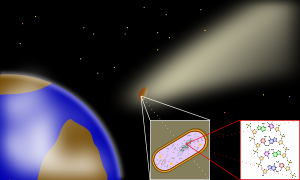
Panspermia proposes that bodies much arsenic comets transported life history forms so much as bacteria—complete with their DNA—through space to the Earth
Panspermia (from Old Greek πᾶν (Pan) 'completely', and σπέρμα (sperma) 'seed') is the hypothesis that life exists passim the Universe, distributed by blank space disperse,[1] meteoroids,[2] asteroids, comets,[3] and planetoids,[4] as wellspring as by spacecraft carrying unintended contamination by microorganisms.[5] [6] [7] Panspermia is a fringe theory with little support amongst mainstream scientists.[8] Critics argue that it does not answer the question of the origin of life but merely places IT on another celestial body. It was also criticized because it was thought it could not be tested experimentally.[9]
Panspermia hypotheses propose (for example) that microscopic life-forms that can survive the effects of distance (such as extremophiles) can become unfree in dust ejected into infinite after collisions between planets and small Solar System bodies that harbor life.[10] Panspermia studies concentrate not connected how life began, just on methods that may administer it in the Universe.[11] [12] [13]
Role playe-panspermia (sometimes called soft panspermia or building block panspermia) argues that the pre-biotic organic edifice-blocks of life originated in space, became incorporated in the solar nebula from which planets condensed, and were farther—and continuously—distributed to planetary surfaces where life then emerged (autogeny).[14] [15]
History [edit]
The first known mention of the terminal figure was in the writings of the fifth-century BC Balkan country philosopher Anaxagoras.[16] Panspermia began to take for granted a more scientific form through the proposals of Jöns Jacob Berzelius (1834),[17] Hermann E. Richter (1865),[18] Kelvin (1871),[19] Hermann von Baron Hermann Ludwig Ferdinand von Helmholt (1879)[20] [21] and finally reaching the level of a detailed scientific hypothesis through the efforts of the Swedish pharmacist Svante Arrhenius (1903).[22]
Fred Hoyle (1915–2001) and Chandra Wickramasinghe (born 1939) were prestigious proponents of panspermia.[23] [24] In 1974 they projected the supposition that some dust in interstellar space was largely organic (containing carbon), which Wickramasinghe later proved to glucinium correct.[25] [26] [27] Hoyle and Wickramasinghe further contended that life-time forms carry on to infix the Earth's ambiance, and may be responsible for epidemic outbreaks, new diseases, and the genetic novelty necessary for macroevolution.[28]
Three serial of space biology experiments have been conducted outside the International Space laboratory between 2008 and 2015 (EXPOSE) where a bird's-eye variety of biomolecules, microorganisms, and their spores were unclothed to the solar flux and vacuity of space for active 1.5 long time. About organisms survived in an inactive state for significant lengths of time,[29] [30] and those samples sheltered away simulated meteorite material provide experimental evidence for the likelihood of the hypothetical scenario of lithopanspermia.[31]
In October 2018, Harvard astronomers bestowed an analytical model that suggests matter—and potentially dormant spores—can be changed across the vast distances between galaxies, a process termed 'galactic panspermia', and not be restricted to the controlled scale of solar systems.[32] [33] The detection of an extra-solar objective named ʻOumuamua crossbreeding the inner Solar System in a hyperbolic orbit confirms the existence of a continuing material tie-in with exoplanetary systems.[34]
In November 2019, scientists reported detecting, for the first time, sugar molecules, including ribose, in meteorites, suggesting that chemical processes on asteroids tin produce some fundamentally essential bio-ingredients important to lifetime, and supporting the notion of an RNA creation prior to a DNA-based origin of life along Dry land, and possibly, too, the notion of panspermia.[35] [36]
Planned mechanisms [edit]
Panspermia can be said to be either interstellar (between leading systems) or interplanetary (between planets in the same star system);[37] [38] its conveyance mechanisms may admit comets,[39] [40] radiation sickness pressure and lithopanspermia (microorganisms embedded in rocks).[41] [42] [43] Interplanetary transfer of non-living material is advantageously documented, as evidenced by meteorites of Martian origin found on Earth.[43] Space probes may also be a viable transport mechanism for interplanetary cross-pollination in the Solar Organization or even beyond. However, place agencies throw implemented planetary protection procedures to reduce the risk of planetary contamination,[44] [45] although, A recently discovered, approximately microorganisms, such as Tersicoccus phoenicis, may be resistant to procedures used in spacecraft assembly clean room facilities.[5] [6]
In 2012, mathematician Edward Belbruno and astronomers Amaya Moro-Martín and Renu Malhotra proposed that gravitational small-energy transfer of rocks among the young planets of stars in their birth cluster is commonplace, and not rare in the general galactic leading population.[46] [47] Deliberate directed panspermia from space to seed Earth[48] or sent from Earth to seed other planetary systems have also been proposed.[49] [50] [51] [52] One twist to the hypothesis by technologist Thomas Dehel (2006), proposes that plasmoid magnetic Fields ejected from the magnetosphere may go up the few spores lifted from the Earth's atmosphere with ample speed to cross celestial body infinite to other systems before the spores can be destroyed.[53] [54] In 2020, Paleobiologist Grzegorz Sadlok proposed the supposition that life can pass over interstellar distances on nomadic exoplanets and/or its exomoons.[55] In 2020, Avi Loeb and Ameer Siraj wrote about the assertable transportation of life by objects shaving the Earth's atmosphere and reaching exoplanetary systems.[56]
Radiopanspermia [cut]
In 1903, Svante Arrhenius published in his article The Distribution of Life in Space,[57] the hypothesis now called radiopanspermia, that microscopic forms of life can be propagated in space, driven aside the radiation pressure from stars.[58] Svante August Arrhenius argued that particles at a critical size below 1.5 μm would be propagated at high accelerate by corpuscular-radiation pressure of the Sun. However, because its effectiveness decreases with increasing size of the particle, this mechanism holds for very tiny particles only, such as single bacterial spores.[59]
The main criticism of radiopanspermia hypothesis came from Iosif Shklovsky and Carl Sagan, WHO pointed out the proofs of the lethal action of space radiation (UV and X-rays) in the cosmos.[60] Regardless of the grounds, Wallis and Wickramasinghe argued in 2004 that the transport of individual bacteria or clumps of bacteria, is irresistibly more important than lithopanspermia in damage of numbers of microbes transferred, even accounting for the death rate of unprotected bacteria in move through.[61]
So, information gathered by the orbital experiments ERA, BIOPAN, EXOSTACK and EXPOSE, determined that isolated spores, including those of B. subtilis, were killed if open to the full infinite environs for merely a a few seconds, but if shielded against star UV, the spores were capable of surviving in blank for in the lead to six years spell embedded in clay or meteorite powder (dummy meteorites).[59] [62]
Minimal aegis is obligatory to shelter a spore against Ultraviolet light radiation: Exposure of unprotected DNA to solar UV and cosmic ionised radiation sickness break it up into its constituent bases.[63] [64] [65] Also, exposing Desoxyribonucleic acid to the ultrahigh vacuum cleaner of blank alone is sufficient to effort Deoxyribonucleic acid damage, so the transport of unprotected DNA operating theater RNA during interplanetary flights powered exclusively by light pressure is extremely unlikely.[65]
The feasibleness of other means of transport for the more massive shielded spores into the outer Solar System—for example, done gravitational capture by comets—is at this time unknown.
Based happening experimental data on radiation effects and Desoxyribonucleic acid stability, it has been concluded that for such long travel times, rocks that are greater than operating theatre equalize to 1 cadence in diam are required to effectively shield nonabsorptive microorganisms, such equally bacterial spores against galactic cosmic irradiatio.[66] [67] These results clearly negate the radiopanspermia hypothesis, which requires sole spores accelerated past the radiation pressure of the Sun, requiring many years to go up 'tween the planets, and support the likelihood of interplanetary transfer of microorganisms within asteroids or comets, the so-called lithopanspermia hypothesis.[59] [62]
Lithopanspermia [edit]
Lithopanspermia, the transfer of organisms in rocks from one planet to other either through interplanetary or interstellar space, remains speculative. Although there is no evidence that lithopanspermia has occurred in the Solar System, the versatile stages take over become conformable to experimental testing.[9]
- Worldwide ejection – For lithopanspermia to occur, researchers undergo suggested that microorganisms must survive ejection from a planetary surface, which involves extreme forces of acceleration and shock with associated temperature excursions. Hypothetical values of ball over pressures experienced by ejected rocks are obtained with Martian meteorites, which suggest the shock pressures of approximately 5 to 55 GPa, acceleration of 3 Mm/s2 and jerk of 6 Gm/s3 and post-shock temperature increases of about 1 K to 1000 K.[68] [69] To determine the effect of speedup during ejection on microorganisms, reave and ultracentrifuge methods were successfully used below simulated outer space conditions.[9]
- Survival of the fittest in transit – The survival of the fittest of microorganisms has been studied extensively using some simulated facilities and in low Earth orbit. A large number of microorganisms have been selected for exposure experiments. It is possible to unshared these microorganisms into cardinal groups, the human-borne, and the extremophiles. Perusing the human-borne microorganisms is significant for humanlike welfare and future crewed missions; whilst the extremophiles are live for studying the physiologic requirements of endurance in space.[9]
- Atmospheric entry – An important aspect of the lithopanspermia hypothesis to exam is that microbes placed along Oregon within rocks could live on hypervelocity entry from space through Earth's atmosphere (Cockell, 2008). As with planetary ejection, this is experimentally docile, with sounding rockets and orbital vehicles beingness used for microbiological experiments.[9] [68] B. subtilis spores inoculated onto granite domes were subjected to hypervelocity atmospheric transit (twice) by launch to a ∼120 km altitude on an Orion two-stage rocket. The spores were shown to have survived connected the sides of the careen, but they did not survive on the forward-moving-facing open that was subjected to a maximum temperature of 145 °C.[70] The exogenous arrival of chemical action microorganisms could get quite thoughtful consequences for the course of biological evolution connected the inoculated planet. Eastern Samoa photosynthetic organisms mustiness be faithful to the surface of a rock to receive ample light vitality, atmospheric transit might play as a filter against them by ablating the surface layers of the rock. Although cyanobacteria have been shown to outlast the desiccating, freezing conditions of blank space in orbital experiments, this would follow of no benefit as the Rock experiment showed that they cannot live on part entry.[71] Hence, non-chemical action organisms deep within rocks have a chance to survive the going and entry process. (See also: Impact survival.) Enquiry presented at the European Planetary Scientific discipline Congress in 2015 suggests that exclusion, entry and impact is survivable for around simple organisms.[72] [73]
However, it has been argued, that even if organisms survive all 3 stages, the possibility of their immediate survival along a New World even so remain relatively low.[74]
Accidental panspermia [edit]
Thomas Metal, a professor of astronomy, suggested in 1960 the hypothesis of "Cosmic Garbage", that animation on Earth mightiness have originated accidentally from a lot of waste products dumped on Ground long since by extraterrestrial beings.[75]
Directed panspermia [edit]
Directed panspermia concerns the deliberate transport of microorganisms in quad, sent to Ground to start life hither, or sent from Earth to ejaculate new international systems with life by introduced species of microorganisms along lifeless planets. The Nobel prize winner Francis Wrick, along with Leslie Orgel planned that life May get been purposely spread by an late alien civilization,[48] but considering an early "RNA world-wide" Francis Henry Compton Crick noted later that life May feature originated on Earth.[76] It has been suggested that 'directed' panspermia was proposed in order to undermine various objections, including the argument that microbes would follow inactivated by the space environment and cosmic radiation before they could make a run a risk encounter with Earth.[66]
Conversely, about oriented panspermia has been planned to secure and expand life in space.[51] This may be motivated by biotic ethics that values, and seeks to propagate the basic patterns of our organic gene/protein biography-form.[77]
A list of publications since 1979 have proposed the idea that directed panspermia could be demonstrated to glucinium the origin of all life on Ground if a distinctive 'theme song' message were found, intentionally constituted into either the genome or the genetical code of the initial microorganisms by our hypothetical progenitor.[78] [79] [80] [81]
Pseudo-panspermia [edit]
Pseudo-panspermia (sometimes called soft panspermia, unit panspermia or quasi-panspermia) proposes that the organic molecules used for life originated in space and were incorporated in the star nebula, from which the planets condensed and were boost—and continuously—distributed to planetary surfaces where life then emerged (abiogenesis).[14] [15] From the early 1970s it was becoming evident that interstellar dust consisted of a large component of organic molecules. The first suggestion came from Chandra Wickramasinghe, WHO proposed a compound theme supported the atom formaldehyde (CH2O).[82]
Interstellar molecules are formed aside chemical reactions within precise sparse heavenly body or circumstellar clouds of dust and gas. Usually this occurs when a molecule becomes ionized, often arsenic the result of an interaction with cosmic rays. This positively emotional particle then draws in a nearby reactant by electrostatic attractive feature of the neutral molecule's electrons. Molecules can also be generated aside reactions 'tween achromatic atoms and molecules, although this process is generally slower.[83] The dust plays a indispensable character of shielding the molecules from the ionizing effect of ultraviolet radiation emitted by stars.[84] Mathematician Jason Guillory in his 2008 analysis of 12C/13C isotopic ratios of organic compounds plant in the Murchison meteorite indicates a non-terrestrial origination for these molecules rather than terrestrial contaminant. Biologically relevant molecules identified soh outlying include uracil (an RNA nucleobase), and xanthine.[85] [86] These results demonstrate that many organic compounds which are components of sprightliness on Earth were already present in the early Solar System and may take in played a key role in life's origin.[87]
In August 2009, NASA scientists known one of the fundamental chemical building-blocks of life (the alkane acid glycine) in a comet for the first time.[88]
In August 2011, a report, based happening NASA studies with meteorites found on Earth, was published suggesting building blocks of Desoxyribonucleic acid (A, guanine and related organic fertilizer molecules) whitethorn have been formed extraterrestrially in outer space.[89] [90] In Oct 2011, scientists according that cosmic debris contains complex organic matter ("amorphous healthful solids with a mixed aromatic-aliphatic structure") that could be created naturally, and speedily, by stars.[91] [92] One of the scientists suggested that these complex organic compounds may have been related to the development of life on Earth and said that, "If this is the case, life on Earth Crataegus oxycantha have had an easier time acquiring started as these organics can serve as primary ingredients for life."[91]
In August 2012, and in a world archetypical, astronomers at Copenhagen University reported the detection of a specific sugar mote, glycolaldehyde, in a distant star system of rules. The molecule was base around the protostellar binary IRAS 16293-2422, which is located 400 get down years from Earth.[93] [94] Glycolaldehyde is needed to form RNA, or RNA, which is kindred in function to DNA. This finding suggests that complex organic molecules may form in stellar systems prior to the formation of planets, sooner or later arriving on young planets early in their formation.[95]
In Sept 2012, NASA scientists according that polycyclic aromatic hydrocarbons (PAHs), subjected to interstellar medium (ISM) conditions, are transformed, through hydrogenation, oxygenation and hydroxylation, to more than complex organics—"a step on the path toward amino acids and nucleotides, the unpolished materials of proteins and Deoxyribonucleic acid, severally".[96] [97] Further, as a result of these transformations, the PAHs lose their qualitative analysis signature which could be one of the reasons "for the lack of PAH detection in interstellar ice grains, particularly the outmost regions of cold, dense clouds operating theater the upper molecular layers of protoplanetary disks."[96] [97]
In 2013, the Atacama Large Millimeter Array (ALMA Project) habitual that researchers have ascertained an important yoke of prebiotic molecules in the icy particles in interstellar space (ISM). The chemicals, found in a giant cloud of gas about 25,000 light-years from Earth in ISM, English hawthorn be a herald to a key component of DNA and the other Crataegus laevigata have a persona in the formation of an important amino acid. Researchers institute a atom titled cyanomethanimine, which produces adenine, matchless of the quaternion nucleobases that form the "rungs" in the ladder-like structure of Deoxyribonucleic acid.[98]
The strange molecule, called ethanamine, is thought to play a role in forming alanine, one of the twenty paraffin series acids in the genetic encode. Previously, scientists thought such processes took place in the very tenuous tout between the stars. The hot discoveries, however, suggest that the chemical formation sequences for these molecules occurred non in gas, merely happening the surfaces of ice grains in interstellar space.[98] NASA ALMA scientist Anthony Remijan stated that finding these molecules in an interstellar gas sully means that important edifice blocks for DNA and amino acids pot 'seeded player' newly formed planets with the chemical precursors for living.[99]
In March 2013, a simulation experiment indicate that dipeptides (pairs of amino acids) that pot glucinium edifice blocks of proteins, can be created in celestial body dust.[100]
In February 2014, NASA proclaimed a greatly upgraded database for tracking polycyclic aromatic hydrocarbons (PAHs) in the universe. According to scientists, to a higher degree 20% of the carbon paper in the universe may be associated with PAHs, imaginable starting materials for the formation of life. PAHs seem to receive been formed shortly later the Bigger Bang, are widespread throughout the macrocos, and are associated with untested stars and exoplanets.[101]
In Parade 2015, NASA scientists reported that, for the first base time, complex DNA and RNA organic compounds of life, including uracil, cytosine and thymine, have been formed in the laboratory below outer space conditions, using starting chemicals, such as pyrimidine, ground in meteorites. Pyrimidine, like polycyclic aromatic hydrocarbons (PAHs), the most carbon-rich chemical substance saved in the Universe, whitethorn wealthy person been formed in red giants or in interstellar dust and gas clouds, according to the scientists.[102]
In Crataegus laevigata 2016, the Rosetta Mission team reported the presence of glycine, methylamine and ethylamine in the coma of 67P/Churyumov-Gerasimenko.[103] This, plus the espial of phosphorus, is consistent with the guess that comets played a crucial role in the emergence of living on Solid ground.
In 2019, the detection of extraterrestrial sugars in meteorites implied the possibility that terrestrial planet sugars may deliver contributed to forming working biopolymers like RNA.[104]
Protospermia [edit]
Betül Kaçar, the director of the NASA Astrobiology Consortium MUSE, calls sending the chemical capacity for life to emerge on another planetary consistency protospermia. Reflecting the ethical implications of the possibility that humans are capable of instigating multiple origins of life under a broader array of circumstances than life currently exists, she wrote: "With protospermia, whatever arises after we supply a poke at toward biogeny would be just as much a product of that surround as our life is of Earth. It would be unusual and 'of' that destination body as very much like its rocks along the ground and the gasses in its atm."[105]
[edit]
Accordant to the panspermia hypothesis, little life—unfocused by meteoroids, asteroids and other small Star System bodies—Crataegus laevigata exist end-to-end the existence.[106] Of the bodies on which life is possible, living organisms could most easily enter the other bodies of the Solar System from Enceladus.[107] IT is more often than not agreed that the conditions mandatory for the evolution of ready biography as we know it are probably exceedingly rare in the universe, while at the same time noting that simple respective-celled microorganisms may be more likely. [108]
[edit]
Hoyle and Wickramasinghe have speculated that several outbreaks of illnesses on World are of extraterrestrial origins, including the 1918 flu pandemic, and certain outbreaks of polio and mad cow disease. For the 1918 flu pandemic they hypothesized that cometary detritus brought the virus to Earth simultaneously at multiple locations—a view almost universally laid-off by experts on this pandemic[ citation requisite ]. Hoyle likewise speculated that HIV came from outside space.[109]
After Edmond Hoyle's death, The Lancet published a letter of the alphabet to the editor from Wickramasinghe and two of his colleagues,[110] in which they hypothesized that the virus that causes severe acute respiratory syndrome (SARS) could be extraterrestrial being in origin and not originated from chickens. The Lancet after published three responses to this letter, showing that the theory was not evidence-based, and casting doubts on the quality of the experiments cited by Wickramasinghe in his letter.[111] [112] [113] A 2008 encyclopedia notes that "The like other claims linking terrestrial disease to extraterrestrial pathogens, this proposal was rejected away the greater research community."[109]
Case studies [edit]
- Various researchers have retrieved bacteria from the stratosphere since the 1970s.[114] Atmospheric sample by NASA in 2010 ahead and after hurricanes, self-collected 314 different types of bacteria; the field of study suggests that extensive-scale convection during tropical storms and hurricanes can then carry this bodily from the superficial high up into the aura.[115] [116]
- A meteorite originating from Mars called ALH84001 was shown in 1996 to contain microscopic structures resembling small terrestrial nanobacteria. When the find was announced, umpteen immediately conjectured that these were fossils and were the first evidence of extraterrestrial life history—making headlines around the world. Public occupy soon started to dwindle As most experts started to agree that these structures were non indicative of life, but could instead be formed abiotically from organic molecules. However, in Nov 2009, a team of scientists at Johnson Space Concentrate on, including David McKay, reasserted that there was "strong evidence that life may have existed on ancient Mars", after having reexamined the meteorite and finding magnetite crystals.[117] [118]
- Connected May 11, 2001, ii researchers from the University of Naples set up viable terrestrial planet bacterium inside a meteorite. Geologist Bruno D'Argenio and unit biologist Giuseppe Geraci found the bacterium wedged inside the crystal anatomical structure of minerals, but were resurrected when a sample of the stone was situated in a medium. British Polar Survey member, David Wynn-Williams responded, pointing out that the bacteria could have been contamination from earthly concern. Luigi Colangelli of the Capodimonte Observatory in Naples noted that the results were indeterminate.[119] [120] [121]
- An American Indian and British team up of researchers led by Chandra Wickramasinghe reported along 2001 that air samples over Hyderabad, Bharat, gathered from the stratosphere by the Indian Space Enquiry Organisation (ISRO) on January 21, 2001, contained clumps of living cells.[122] Wickramasinghe calls this "unambiguous evidence for the front of clumps of living cells in atmosphere samples from as high as 41 km, above which nobelium air from glower down in the mouth would unremarkably be transported".[123] [124] Ii bacterial and one fungal species were by and by independently isolated from these filters which were known as B simplex, Staphylococcus pasteuri and Engyodontium record album severally.[125] [126] Pushkar Ganesh Vaidya from the Indian Exobiology Research Pore rumored in 2009 that "the three microorganisms captured during the balloon experiment do non exhibit some distinct adaptations expectable to be seen in microorganisms occupying a cometary niche".[127] [128]
- In 2005 an cleared experiment was conducted away ISRO. On April 20, 2005, air samples were gathered from the upper atmosphere at altitudes ranging from 20 klick to to a higher degree 40 kilometer.[129] The samples were tested at deuce labs in India. The labs found 12 bacterial and 6 different plant life species in these samples. The fungi were Penicillium decumbens, Cladosporium cladosporioides, Alternaria sp. and Tilletiopsis albescens. Out of the 12 bacterial samples, three were identified as new species and named Janibacter hoylei (after Hoyle), Bacillus isronensis (named after ISRO) and Bacillus aryabhattai (named afterward the old Amerindic mathematician, Aryabhata). These three new species showed that they were much resistant to UV radiation than similar bacteria.[130]
- In 2013, Dale Warren Griffin, a microbiologist working at the United States Geological Go over noticeable that viruses are the near numerous entities on Earth. Griffin speculates that viruses evolved in comets and on otherwise planets and moons may be infective to humans, sol he proposed to also look for viruses on moons and planets of the Solar Arrangement.[131]
Hoaxes [edit]
A separate fragment of the Orgueil meteorite (kept in a sealed glass jar since its discovery) was recovered in 1965 to have a seed ejector seat integrated in it, whilst the original glassy layer on the outside remained untroubled. Contempt great initial excitement, the sow was recovered to be that of a European Juncaceae or Rush found that had been glued into the break up and camouflaged using coal dust. The outer "fusion layer" was in fact glue. Whilst the perpetrator of this fraudulence is chartless, it is thought that they sought to influence the 19th century debate on spontaneous propagation—rather than panspermia—by demonstrating the transformation of inorganic to biological matter.[132]
Extremophiles [edit]

Until the 1970s, life was cerebration to depend connected its approach to sunshine. Even life in the ocean depths, where sunlight cannot strain, was believed to obtain its nourishment either from overwhelming organic detritus rained downfield from the skin-deep waters or from eating animals that did.[133] It is now glorious that extremophiles, microorganisms with extraordinary capability to expand in the harshest environments on Dry land, can specialize to thrive in the deep-sea,[134] [135] [136] ice, stewing water, venomous, the water core of nuclear reactors, salt crystals, nephrotoxic waste and in a chain of otherwise extreme habitats that were previously thought to comprise inhospitable for life.[137] [138] [139] [140] Living bacterium establish in ice core samples retrieved from 3,700 metres (12,100 ft) deep at Lake Vostok in Antarctica, have provided data for extrapolations to the likelihood of microorganisms surviving glaciated in extraterrestrial habitats or during heavenly body transport.[141] Systematic to test many of these organisms' potential resilience in outer space, plant seeds and spores of bacteria, fungi and ferns undergo been exposed to the heavy space environment.[139] [140] [142]
Research in outermost place [edit]
The question of whether indisputable microorganisms can endure in the mealy environment of outer place has intrigued biologists since the beginning of spaceflight, and opportunities were provided to expose samples to space. The premier Ground tests were made in 1966, during the Gemini Cardinal and Cardinal missions, when samples of bacteriophage T1 and spores of Penicillium roqueforti were exposed to outer space for 16.8 h and 6.5 h, respectively.[59] [9] Other basic lifespan sciences research in soft Worldly concern orbit started in 1966 with the Soviet biosatellite computer programme Bion and the U.S. Biosatellite program. Thus, the plausibility of panspermia can be evaluated aside examining life history forms on Earth for their capacity to outlast in space.[143] The pursual experiments carried along low-spirited Earth orbit specifically tested some aspects of panspermia operating theatre lithopanspermia:
Geological era [edit]

EURECA facility deployment in 1992
The Exobiology Radiation Assembly (ERA) was a 1992 experimentation on board the European Retrievable Carrier (EURECA) on the biological effects of space radiation. EURECA was an uncrewed 4.5 MT satellite with a payload of 15 experiments.[144] It was an exobiology delegation developed by the European Space Agency (ESA). Spores of contrastive strains of Bacillus subtilis and the Escherichia coli plasmid pUC19 were exposed to selected conditions of infinite (space hoover and/or settled wavebands and intensities of solar ultraviolet light). After the approximately 11-month mission, their responses were studied in terms of endurance, mutagenesis in the his (B. subtilis) or lac locale (pUC19), induction of DNA strand breaks, efficiency of DNA mend systems, and the role of external protective agents. The information were compared with those of a simultaneously running ground control experiment:[145] [146]
- The survival of spores treated with the vacuum of space, however shielded against solar radiation, is substantially increased, if they are unprotected in multilayers and/operating room in the presence of glucose as protective.
- All spores in "false meteorites", i.e. integrated in clays or imitative Martian soil, are killed.
- Vacuum treatment leads to an addition of mutation relative frequency in spores, but non in plasmid DNA.
- Extraterrestrial solar ultraviolet radiation is mutagenic, induces string breaks in the DNA and reduces selection well.
- Military action spectroscopy confirms results of previous space experiments of a synergistic action of space vacuum and solar UV radiation with DNA being the critical target.
- The decrease in viability of the microorganisms could be correlated with the increase in DNA damage.
- The purple membranes, amino acids and urea were non measurably affected aside the dehydrating condition of open space, if sheltered from solar radiation syndrome. Plasmid DNA, however, suffered a significant amount of Strand breaks under these conditions.[145]
BIOPAN [edit]
BIOPAN is a multi-user experimental facility installed on the outer surface of the Country Foton descent capsule. Experiments developed for BIOPAN are studied to investigate the effect of the space surroundings on biological material after exposure between 13 and 17 days.[147] The experiments in BIOPAN are unprotected to solar and cosmic radiation, the space void and weightlessness, or a selection thence. Of the 6 missions flown thus far on BIOPAN between 1992 and 2007, dozens of experiments were conducted, and some analyzed the likelihood of panspermia. Some bacteria, lichens (Xanthoria elegans, Rhizocarpon geographicum and their mycobiont cultures, the black Antarctic microfungi Cryomyces minteri and Cryomyces antarcticus), spores, and even one frog-like (tardigrades) were found to have survived the harsh outer space environment and cosmic radiation.[148] [149] [150] [151]
EXOSTACK [edit]

The German EXOSTACK experiment was deployed on 7 April 1984 on board the Long Duration Exposure Facility satellite. 30% of Bacillus subtilis spores survived the nearly 6 days exposure when embedded in salt crystals, whereas 80% survived in the presence of glucose, which stabilize the structure of the cellular macromolecules, especially during vacuum-induced dehydration.[59] [152]
If shielded against solar UV, spores of B. subtilis were capable of surviving in space for up to 6 years, specially if embedded in clay or meteorite powder (artificial meteorites). The information support the likelihood of interplanetary transfer of microorganisms within meteorites, the so-known as lithopanspermia surmisal.[59]
EXPOSE [edit]

EXPOSE is a multi-user deftness adorned extraneous the International Space Place dedicated to astrobiology experiments.[142] There undergo been deuce-ac EXPOSE experiments flown between 2008 and 2015: Queer-E, EXPOSE-R and Reveal-R2.
Results from the cavum missions, especially the experiments SEEDS [153] and LiFE,[154] concluded that after an 18-month exposure, some seeds and lichens (Stichococcus sp. and Acarospora sp., a lichenized fungal genus) may be capable to subsist interplanetary travel if sheltered inside comets or rocks from cosmic radiation and Ultraviolet illumination radiation.[142] [155] The LIFE, SPORES, and SEEDS parts of the experiments provided entropy nigh the likeliness of lithopanspermia.[156] [157] [158] These studies volition provide experimental data to the lithopanspermia conjecture,[157] and they will put up basic data to planetary protection issues.
Tanpopo [edit]

The Tanpopo mission is an orbital space biology experiment by Japan that is currently investigating the possible celestial body transfer of life, organic compounds, and possible object particles in low Earth orbit. The Tanpopo try out took place at the Exposed Installation situated on the exterior of Kibo module of the International Infinite Station. The mission collected large dusts and other particles for three years aside using an ultra-low density silica gel called aerogel. The purpose is to assess the panspermia hypothesis and the possibility of natural celestial body transport of life and its precursors.[159] [160] Some of these aerogels were replaced every one operating theatre 2 years done 2018.[161] Sample collection began in May 2015, and the first samples were returned to Earth in mid-2016.[162] In August 2020, scientists according that bacteria from Earth, specially Deinococcus radiodurans bacterium, which is highly nonabsorptive to environmental hazards, were found to survive for three years in outer space, based along studies conducted on the International Space platform.[163] [164]
Hayabusa2 [blue-pencil]
Hayabusa2 is an asteroid sample-return delegation. In 2020, the spacecraft brought back a capsule containing a try of carbon-rich star-shaped dot from the asteroid 162173 Ryugu. [165] Scientists believe this could provide clues about the ancient delivery of water and organic molecules to World. Seiichiro Watanabe from the Hayabusa project said: "There are very much of samples and it seems they contain whole lot of constituent weigh, so I hope we backside find out umteen things about how organic substances have developed on the rear body of Ryugu."[166]
See also [cut]
- Abiogenesis – Natural process by which life arises from non-living affair
- Astrobiology – Skill concerned with life history in the universe of discourse
- Cryptobiosis
- List of microorganisms tested in outer space – Wikipedia list clause
- Planetary trade protection – Guiding principle in the purpose of an interplanetary missionary post, aiming to prevent biological taint of both the quarry celestial body and the Earth
References [edit]
- ^ Berera, Arjun (6 November 2017). "Space disperse collisions as a worldwide escape mechanics". Astrobiology. 17 (12): 1274–82. arXiv:1711.01895. Bibcode:2017AsBio..17.1274B. doi:10.1089/ast.2017.1662. PMID 29148823. S2CID 126012488.
- ^ Chan, Queenie H. S. et AL. (10 January 2018). "Organic matter in extraterrestrial water-bearing salt crystals". Science Advances. 4 (1): eaao3521. Bibcode:2018SciA....4O3521C. doi:10.1126/sciadv.aao3521. PMC5770164. PMID 29349297. CS1 maint: uses authors parametric quantity (link)
- ^ Wickramasinghe, Chandra (2011). "Micro-organism morphologies supporting cometary panspermia: a reappraisal". International Daybook of Astrobiology. 10 (1): 25–30. Bibcode:2011IJAsB..10...25W. CiteSeerX10.1.1.368.4449. doi:10.1017/S1473550410000157. S2CID 7262449.
- ^ Rampelotto, P. H. (2010). "Panspermia: A promising field of research" (PDF). Exobiology Science Conference. 1538: 5224. Bibcode:2010LPICo1538.5224R.
- ^ a b Forward heavenly body contamination like Tersicoccus phoenicis, that has shown resistance to methods unremarkably used in spacecraft fabrication fairly suite: Madhusoodanan, Jyoti (May 19, 2014). "Microbial stowaways to Mars identified". Nature. Department of the Interior:10.1038/nature.2014.15249. S2CID 87409424.
- ^ a b Webster, Guy (Nov 6, 2013). "Rare New Microbe Set up in Ii Reserved Immaculate Rooms". NASA.gov . Retrieved November 6, 2013.
- ^ Staff - Purdue University (27 February 2018). "Tesla in space could comport bacteria from Earth". phys.org . Retrieved 28 Feb 2018.
- ^ May, Andrew (2019). Astrobiology: The Search for Life Elsewhere in the Universe. Capital of the United Kingdom. ISBN978-1-78578-342-5. OCLC 999440041.
Although they were part of the scientific administration – Hoyle at Cambridge and Wickramasinghe at the University of Wales – their views on the topic were far from mainstream, and panspermia corpse a periphery theory
- ^ a b c d e f Olsson-Francis, Karen; Cockell, Charles S. (2010). "Experimental methods for studying microorganism survival in extraterrestrial environments". Daybook of Microbiological Methods. 80 (1): 1–13. Interior:10.1016/j.mimet.2009.10.004. PMID 19854226.
- ^ Chotiner, Isaac (8 July 2019). "What If Life Did Not Arise on Earth?". The Unexampled Yorker. ISSN 0028-792X. Retrieved 10 July 2019.
- ^ A variation of the panspermia hypothesis is necropanspermia which astronomer Paul Wesson describes as follows: "The large majority of organisms gain a new home in the Whitish Way in a technically gone State Department … Resurrection may, nevertheless, be possible." Grossman, Lisa (2010-11-10). "All Life on Earth Could Have Come From Alien Zombies". Wired . Retrieved 10 November 2010.
- ^ Hoyle, F. and Wickramasinghe, N.C. (1981). Phylogenesis from Space. Simon & Schuster Inc., NY, and J.M. Dent and Word, London (1981), ch3 pp. 35–49.
- ^ Wickramasinghe, J., Wickramasinghe, C. and Napier, W. (2010). Comets and the Origin of Life sentence. International Scientific, Singapore. ch. 6 pp. 137–54. ISBN 978-981-256-635-5
- ^ a b Klyce, Brig (2001). "Panspermia Asks New Questions". Retrieved 25 July 2013.
- ^ a b Klyce, Brig (2001). "Panspermia asks new questions". In Kingsley, Stuart A; Bhathal, Ragbir (eds.). The Search for Extraterrestrial Intelligence (SETI) in the Optical Spectrum III. Proc. SPIE. The Search for Extraterrestrial Intelligence (SETI) in the Optical Spectrum III. 4273. pp. 11–14. Bibcode:2001SPIE.4273...11K. Interior:10.1117/12.435366. S2CID 122849901.
- ^ O'Leary, Margater (2008). Anaxagoras and the Origin of Panspermia Theory. iUniverse Publishing Group. ISBN978-0-595-49596-2.
- ^ Berzelius, J. J. (1834). "Analysis of the Alais meteorite and implications about life in other worlds". Liebigs Annalen der Chemie und Pharmacie. 10: 134–35.
- ^ Rothschild, Lynn J.; Lister, Baron Adrian M. (June 2003). Evolution connected Planet Earth – The Affect of the Somatogenetic Environment. Academic Press. pp. 109–27. ISBN978-0-12-598655-7.
- ^ Thomson (Lord Kelvin), W. (1871). "Inaugural Address to the British Tie Edinburgh. 'We must regard it as likely to the highest point that in that respect are countless sow-bearing meteoritic stones moving through and through space.'". Nature. 4 (92): 261–78 [262]. Bibcode:1871Natur...4..261.. doi:10.1038/004261a0. PMC2070380.
- ^ "The Word of God: Panspermia". Newly Scientist (2541). 7 March 2006. Retrieved 25 July 2013.
- ^ "Chronicle of Panspermia". Archived from the archetype on 13 October 2014. Retrieved 25 July 2013.
- ^ Arrhenius, S. (1908). Worlds in the Making: The Evolution of the Universe. New York: Harper & Row. Bibcode:1908wmeu.book.....A.
- ^ Napier, W.M. (2007). "Pollenation of exoplanets aside nebulae". Int. J. Astrobiol. 6 (3): 223–28. Bibcode:2007IJAsB...6..223N. doi:10.1017/S1473550407003710. S2CID 122742509.
- ^ Credit line, M.A. (2007). "Panspermia in the linguistic context of the timing of the origin of life and microbial phylogeny". Int. J. Astrobiol. 3. 6 (3): 249–54. Bibcode:2007IJAsB...6..249L. doi:10.1017/S1473550407003813. S2CID 86569201.
- ^ Wickramasinghe, D. T.; Allen, D. A. (1980). "The 3.4-µm interstellar absorption feature". Nature. 287 (5782): 518–19. Bibcode:1980Natur.287..518W. doi:10.1038/287518a0. S2CID 4352356.
- ^ Allen, D. A.; Wickramasinghe, D. T. (1981). "Diffuse interstellar absorption bands between 2.9 and 4.0 µm". Nature. 294 (5838): 239–40. Bibcode:1981Natur.294..239A. Department of the Interior:10.1038/294239a0. S2CID 4335356.
- ^ Wickramasinghe, D. T.; Allen, D. A. (1983). "Three components of 3–4 μm soaking up bands". Astrophysics and Space Skill. 97 (2): 369–78. Bibcode:1983Ap&SS..97..369W. doi:10.1007/BF00653492. S2CID 121109158.
- ^ Fred Hoyle; Chandra Wickramasinghe & John Watson (1986). Viruses from Space and Related Matters. University College Cardiff Press.
- ^ Cockell, Charles II S. (19 May 2011). "Exposure of phototrophs to 548 days in low Earth orbit: microbic choice pressures in outer blank space and on immature earth". The ISME Daybook. 5 (10): 1671–82. Department of the Interior:10.1038/ismej.2011.46. PMC3176519. PMID 21593797.
- ^ Amos, Jonathan (23 Aug 2010). "Beer microbes live 553 days outside ISS". BBC News . Retrieved 11 February 2016.
- ^ Panitz, Corinna; Horneck, Gerda; Rabbow, Elke; Petra Rettberg, Petra; Moeller, Ralf (January 2015). "The SPORES experiment of the Display-R mission: Bacillus globigii spores in artificial meteorites". International Daybook of Space biology. 14 (Specialized Issue 1): 105–14. Bibcode:2015IJAsB..14..105P. doi:10.1017/S1473550414000251. S2CID 4804915.
- ^ Shostak, Seth (26 October 2018). "Comets and asteroids Crataegus laevigata be spreading life across the galaxy – Are germs from outer space the germ of life on Earth?". NBC Newsworthiness . Retrieved 31 October 2018.
- ^ Ginsburg, Idan; Lingam, Manasvi; Loeb, Abraham (19 November 2018). "Galactic Panspermia". The Astrophysical Daybook Letters. 868 (1): L12. arXiv:1810.04307v2. Bibcode:2018ApJ...868L..12G. doi:10.3847/2041-8213/aaef2d. S2CID 119084109.
- ^ Oumuamua (A/2017U1) – A Confirmation of Golf links 'tween Galactic Wandering Systems. (PDF) N. Chandra Wickramasinghe, Black Prince J. Steele, Daryl. H. Wallis, Robert Synagogue, Gensuke Tokoro, Janaki T. Wickramasinghe. 2018.
- ^ Steigerwald, Bill; Jones, Nancy; Furukawa, Yoshihiro (18 November 2019). "First Detection of Sugars in Meteorites Gives Clues to Origin of Life". National Aeronautics and Space Administration . Retrieved 18 November 2019.
- ^ Furukawa, Yoshihiro; et aluminum. (18 November 2019). "Extraterrestrial ribose and other sugars in primitive meteorites". Proceeding of the National Academy of Sciences of the America. 116 (49): 24440–45. Bibcode:2019PNAS..11624440F. doi:10.1073/pnas.1907169116. PMC6900709. PMID 31740594.
- ^ Khan, Amina (7 March 2014). "Did two planets around nearby star collide? Toxic tout holds hints". Pelican State Multiplication . Retrieved 9 March 2014.
- ^ Dent, W. R. F.; Wyatt, M. C.; Roberge, A.; et al. (6 Borderland 2014). "Molecular Petrol Clumps from the Destruction of Icy Bodies in the β Pictoris Rubble Disk". Science. 343 (6178): 1490–92. arXiv:1404.1380. Bibcode:2014Sci...343.1490D. DoI:10.1126/science.1248726. PMID 24603151. S2CID 206553853.
- ^ Wickramasinghe, Chandra; Wickramasinghe, Chandra; Napier, William (2009). Comets and the Origin of Life. World Knowledge base Press. Department of the Interior:10.1142/6008. ISBN978-981-256-635-5.
- ^ Wall, Microphone. "Comet Impacts May Have Jump-Started Life on Earth". space.com . Retrieved 1 August 2013.
- ^ Weber, P; Greenberg, J. M. (1985). "Can spores survive in celestial body space?". Nature. 316 (6027): 403–07. Bibcode:1985Natur.316..403W. DoI:10.1038/316403a0. S2CID 4351813.
- ^ Melosh, H. J. (1988). "The rocky road to panspermia". Nature. 332 (6166): 687–88. Bibcode:1988Natur.332..687M. doi:10.1038/332687a0. PMID 11536601. S2CID 30762112.
- ^ a b C. Mileikowsky; F. A. Cucinotta; J. W. Wilson; et al. (2000). "Risks threatening viable transfer of microbes between bodies in our solar system". World-wide and Space Science. 48 (11): 1107–15. Bibcode:2000P&SS...48.1107M. doi:10.1016/S0032-0633(00)00085-4.
- ^ "Studies Focus Along Spacecraft Sterilization". The Aerospace Corporation. July 30, 2000. Archived from the daring happening 2006-05-02.
- ^ "Dry heat sterilization process to high temperatures". European Space Federal agency. 22 May 2006. Archived from the original on 2012-02-01.
- ^ Edward VII Belbruno; Amaya Moro-Martı´n; Malhotra, Renu & Savransky, Dmitry (2012). "Wild Exchange of Solid Material betwixt Planetary". Astrobiology. 12 (8): 754–74. arXiv:1205.1059. Bibcode:2012AsBio..12..754B. doi:10.1089/ast.2012.0825. PMC3440031. PMID 22897115.
- ^ Kelly, Morgan (September 24, 2012). "Slow-moving rocks better odds that life story crashed to World from space". Princeton University.
- ^ a b Crick, F. H.; Orgel, L. E. (1973). "Oriented Panspermia". Icarus. 19 (3): 341–48. Bibcode:1973Icar...19..341C. CiteSeerX10.1.1.599.5067. doi:10.1016/0019-1035(73)90110-3.
- ^ Mautner, Michael N. (2000). Seeding the Universe of discourse with Life: Securing Our Cosmogonic Early (PDF). Washington District of Columbia. ISBN978-0-476-00330-9.
- ^ Mautner, M; Matloff, G. (1979). "Directed panspermia: A technical valuation of seeding nearby global systems" (PDF). Journal of the British Heavenly body Society. 32: 419. Bibcode:1979JBIS...32..419M.
- ^ a b Mautner, M. N. (1997). "Directed panspermia. 3. Strategies and motivation for seeding star-forming clouds" (PDF). Journal of the British Interplanetary Club. 50: 93–102. Bibcode:1997JBIS...50...93M.
- ^ "Impacts 'more likely' to have gap biography from Earth". BBC. 23 August 2011. Retrieved 24 August 2011.
- ^ Chandler, David L. (21 July 2006). "Electromagnetic space change of location for bugs?". New Scientist. Archived from the original on January 11, 2009. Retrieved December 8, 2014.
- ^ Dehel, T. (2006-07-23). "Uplift and Outflow of Bacterial Spores via Electric Field". 36th COSPAR Scientific Assembly. Held 16–23 July 2006. 36: 1. arXiv:hip-ph/0612311. Bibcode:2006cosp...36....1D.
- ^ Sadlok, Grzegorz (2020-02-07). "On A Hypothetical Chemical mechanism of Interstellar Life Transfer Gutter Roving Objects". Origins of Life sentence and Evolution of Biospheres. 50 (1–2): 87–96. Bibcode:2020OLEB...50...87S. Interior Department:10.1007/s11084-020-09591-z. ISSN 1573-0875. PMID 32034615.
- ^ Siraj, Amir; Loeb, Ibrahim (2020-04-17). "Possible Transfer of Life by Earth-Grazing Objects to Exoplanetary Systems". Sprightliness. 10 (4): 44. arXiv:2001.02235. doi:10.3390/life10040044. ISSN 2075-1729. PMC7235815. PMID 32316564.
- ^ Svante August Arrhenius, Svante (1903). "Die Verbreitung des Lebens im Weltenraum" [The Dispersion of Life in Space]. Die Umschau (in European country).
- ^ Nicholson, Mad Anthony Wayne L. (2009). "Ancient micronauts: Interplanetary transport of microbes by cosmic impacts". Trends in Microbiology. 17 (6): 243–50. Department of the Interior:10.1016/j.tim.2009.03.004. PMID 19464895.
- ^ a b c d e f Horneck, G.; Klaus, D. M.; Mancinelli, R. L. (2010). "Space Microbiology". Microbiology and Molecular Biology Reviews. 74 (1): 121–56. Bibcode:2010MMBR...74..121H. Interior:10.1128/MMBR.00016-09. PMC2832349. PMID 20197502.
- ^ Shklovskii, I.S.; Sagan, Carl (1966). Ready Life in the Universe. Emerson-Adams Press. ISBN978-1-892803-02-3. [ page needed ]
- ^ Wickramasinghe, M.K.; Wickramasinghe, C. (2004). "Interstellar transfer of planetary microbiota". Monthly Notices of the Head of state Astronomical Club. 348 (1): 52–57. Bibcode:2004MNRAS.348...52W. DoI:10.1111/j.1365-2966.2004.07355.x.
- ^ a b Horneck, G.; Rettberg, P.; Reitz, G.; et Alabama. (2001). "Protection of bacterial spores in space, a contribution to the word on panspermia". Origins of Life story and Evolution of the Biosphere. 31 (6): 527–47. Bibcode:2002ESASP.518..105R. doi:10.1023/A:1012746130771. PMID 11770260. S2CID 24304433.
- ^ Rahn, R.O.; Hosszu, J.L. (1969). "Influence of comparative humidness on the photochemistry of DNA films". Biochim. Biophys. Acta. 190 (1): 126–31. Department of the Interior:10.1016/0005-2787(69)90161-0. PMID 4898489.
- ^ Patrick, M.H.; Intermediate, D.M. (1976). "Independence of photproduct formation along DNA conformation". Photochem. Photobiol. 24 (6): 507–13. doi:10.1111/j.1751-1097.1976.tb06867.x. PMID 1019243. S2CID 12711656.
- ^ a b Nicholson, Wayne L.; Schuerger, Andrew C.; Setlow, Peter (21 January 2005). "The star UV environs and micro-organism spore UV resistance: considerations for Earth-to-Mars channel by natural processes and human spaceflight" (PDF). Mutation Enquiry. 571 (1–2): 249–64. DoI:10.1016/j.mrfmmm.2004.10.012. PMID 15748651. Archived from the original (PDF) along 28 December 2013. Retrieved 2 Grand 2013.
- ^ a b Clark, Benton C. Clark (February 2001). "Wandering Interchange of Bioactive Material: Probability Factors and Implications". Origins of Life and Evolution of the Biosphere. 31 (1–2): 185–97. Bibcode:2001OLEB...31..185C. Interior:10.1023/A:1006757011007. PMID 11296521. S2CID 12580294.
- ^ Mileikowsky, C.; Cucinotta, F.A.; Wilson, J.W.; et AL. (2000). "Innate transfer of microbes in place, part I: from Mars to Earth and Earth to Mars". Icarus. 145 (2): 391–427. Bibcode:2000Icar..145..391M. doi:10.1006/icar.1999.6317. PMID 11543506.
- ^ a b Cockell, Charles S. (2007). "The Interplanetary Exchange of Photosynthesis". Origins of Sprightliness and Development of Biospheres. 38 (1): 87–104. Bibcode:2008OLEB...38...87C. doi:10.1007/s11084-007-9112-3. PMID 17906941. S2CID 5720456.
- ^ Horneck, Gerda; Stöffler, Dieter; Ott, Sieglinde; et al. (2008). "Microorganism Rock Inhabitants Survive Hypervelocity Impacts on Red Planet-Like Host Planets: First Phase of Lithopanspermia Through an experiment Tested". Astrobiology. 8 (1): 17–44. Bibcode:2008AsBio...8...17H. doi:10.1089/ast.2007.0134. PMID 18237257.
- ^ Fajardo-Cavazos, Patricia; Link, Lindsey; Melosh, H. Jay; Nicholson, Wayne L. (2005). "Bacillus subtilis Spores connected Artificial Meteorites Survive Hypervelocity Atmospheric Entry: Implications for Lithopanspermia". Astrobiology. 5 (6): 726–36. Bibcode:2005AsBio...5..726F. doi:10.1089/ast.2005.5.726. PMID 16379527.
- ^ Cockell, Charles S.; Brack, André; Wynn-Williams, David D.; Baglioni, Pietro; et al. (2007). "Interplanetary Transfer of Photosynthesis: An Experimental Demonstration of a Selective Dispersal Filter in Planetary Island Biogeography". Astrobiology. 7 (1): 1–9. Bibcode:2007AsBio...7....1C. Department of the Interior:10.1089/ast.2006.0038. PMID 17407400.
- ^ "Could Life Have Survived a Fall to Terra firma?". EPSC. 12 September 2013. Retrieved 2015-04-21 .
- ^ Boyle, Rebecca (2017-05-16). "Microbes might thrive after crash-landing place on control board a meteorite". New Scientist . Retrieved 2019-12-11 .
- ^ von Hegner, Ian (2020). "Interplanetary transmissions of life in an evolutionary context". International Journal of Astrobiology. 19 (4): 335–348. arXiv:2003.01624. Bibcode:2020IJAsB..19..335V. doi:10.1017/S1473550420000099. S2CID 211817756.
- ^ Gold, T. "Cosmic Scraps", Air Force and Space Digest, 65 (May 1960).
- ^ Orgel, L E; Crick, F H (January 1993). "Anticipating an RNA world. Roughly past speculations on the parentage of aliveness: where are they nowadays?". The FASEB Journal. 7 (1): 238–239. doi:10.1096/fasebj.7.1.7678564. PMID 7678564. S2CID 11314345.
- ^ Mautner, Michael N. (2009). "Life-centered ethics, and the human coming in space" (PDF). Bioethics. 23 (8): 433–40. doi:10.1111/j.1467-8519.2008.00688.x. PMID 19077128. S2CID 25203457.
- ^ Marx, G. (1979). "Message through time". Acta Astronautica. 6 (1–2): 221–25. Bibcode:1979AcAau...6..221M. doi:10.1016/0094-5765(79)90158-9.
- ^ Yokoo, H.; Oshima, T. (1979). "Is bacteriophage φX174 DNA a message from an extraterrestrial intelligence?". Icarus. 38 (1): 148–53. Bibcode:1979Icar...38..148Y. doi:10.1016/0019-1035(79)90094-0.
- ^ Overbye, Dennis (26 June 2007). "Human DNA, the Ultimate Blob for Secret Messages (Are Much In that respect Now?)". The New York Times . Retrieved 2014-10-09 .
- ^ Davies, Paul C.W. (2010). The Eerie Silence: Renewing Our Hunting for Alien Intelligence. Hub of the Universe, Massachusetts: Houghton Mifflin Harcourt. ISBN978-0-547-13324-9. [ page needed ]
- ^ Wickramasinghe, N.C. (1974). "Formaldehyde Polymers in Heavenly body Space". Nature. 252 (5483): 462–63. Bibcode:1974Natur.252..462W. doi:10.1038/252462a0. S2CID 4260499.
- ^ Dalgarno, A. (2006). "The collection cosmic ray ionization rate". Proceedings of the National Academy of Sciences. 103 (33): 12269–73. Bibcode:2006PNAS..10312269D. doi:10.1073/pnas.0602117103. PMC1567869. PMID 16894166.
- ^ Brown, Laurie M.; Pais, Abraham; Pippard, A. B. (1995). "The physical science of the interstellar medium". 20th Century Physics (second ed.). CRC Iron out. p. 1765. ISBN978-0-7503-0310-1.
- ^ Martins, Zita; Botta, Oliver; Fogel, Marilyn L.; Sephton, Stigmatise A.; Glavin, Book of Daniel P.; Watson, Jonathan S.; Dworkin, Jason P.; Schwartz, Alan W.; Ehrenfreund, Pascale (2008). "Extraterrestrial nucleobases in the Murchison meteorite". Earth and Celestial body Science Letters. 270 (1–2): 130–36. arXiv:0806.2286. Bibcode:2008E&adenylic acid;PSL.270..130M. Interior Department:10.1016/j.epsl.2008.03.026. S2CID 14309508.
- ^ "We may each be space aliens: study". Alpha foetoprotein. 20 August 2009. Archived from the original on June 17, 2008. Retrieved 8 November 2014.
- ^ Martins, Zita; Botta, Oliver; Fogel, Marilyn L.; Sephton, Mark A.; Glavin, Daniel P.; John Broadus Watson, Jonathan S.; Dworkin, Jason P.; Schwartz, Alan W.; Ehrenfreund, Pascale (2008). "Extraterrestrial nucleobases in the Murchison meteorite". Earth and Planetary Science Letters. 270 (1–2): 130–36. arXiv:0806.2286. Bibcode:2008E&PSL.270..130M. Interior:10.1016/j.epsl.2008.03.026. S2CID 14309508.
- ^ "'Life chemical' detected in comet". NASA. BBC News. 18 Lordly 2009. Retrieved 6 March 2010.
- ^ Callahan, M. P.; Smith, K. E.; Cleaves, H. J.; Ruzicka, J.; et al. (2011). "Carbonaceous meteorites contain a wide range of extraterrestrial nucleobases". Proceedings of the National Academy of Sciences. 108 (34): 13995–98. Bibcode:2011PNAS..10813995C. doi:10.1073/pnas.1106493108. PMC3161613. PMID 21836052.
- ^ Steigerwald, John (8 August 2011). "National Aeronautics and Space Administration Researchers: DNA Building Blocks Nates Be Made in Space". NASA. Retrieved 10 Venerable 2011.
- ^ a b Chow, Denise (26 October 2011). "Discovery: Cosmic Dust Contains Organic Matter from Stars". Space.com . Retrieved 26 October 2011.
- ^ Kwok, Sun; Zhang, Yong (2011). "Mixed hydrocarbon–aliphatic organic nanoparticles as carriers of unidentified infrared radiation emission features". Nature. 479 (7371): 80–83. Bibcode:2011Natur.479...80K. Department of the Interior:10.1038/nature10542. PMID 22031328. S2CID 4419859.
- ^ Than, Ker (August 29, 2012). "Sugar Found In Space". National Geographic . Retrieved August 31, 2012.
- ^ "Sweet! Astronomers office sugar molecule near asterisk". AP Newsworthiness. August 29, 2012. Retrieved August 31, 2012.
- ^ Jørgensen, Jes K.; Favre, Cécile; Bisschop, Suzanne E.; Bourke, Tyler L.; et al. (2012). "Spotting of the Simplest Sugar, Glycolaldehyde, in a Star-Typecast Protostar with Alma". The Astrophysical Daybook. 757 (1): L4. arXiv:1208.5498. Bibcode:2012ApJ...757L...4J. doi:10.1088/2041-8205/757/1/L4. S2CID 14205612.
- ^ a b "NASA Cooks Up Icy Organics to Mimicker Life's Origins". Space.com. September 20, 2012. Retrieved Sept 22, 2012.
- ^ a b Gudipati, Murthy S.; Yang, Rui (2012). "In-Situ Probing of Radiation-Induced Processing of Organics in Astrophysical Ice Analogs – Novel Laser Desorption Laser Ionization Time-Of-Flight Mass Spectroscopic Studies". The Astrophysical Diary. 756 (1): L24. Bibcode:2012ApJ...756L..24G. doi:10.1088/2041-8205/756/1/L24.
- ^ a b Loomis, Ryan A.; Zaleski, Daniel P.; Steber, Amanda L.; Neill, Justin L.; et al. (2013). "The Signal detection of Celestial body Ethanimine (Ch3Chnh) from Observations Taken During the Gbt Primos Survey". The Uranology Journal. 765 (1): L9. arXiv:1302.1121. Bibcode:2013ApJ...765L...9L. doi:10.1088/2041-8205/765/1/L9. S2CID 118522676.
- ^ Finley, Dave (February 28, 2013) Discoveries Suggest Wintry Large Initiate for Amino Acids and DNA Ingredients. The Home Radio Uranology Observatory
- ^ Kaiser, R. I.; Stockton, A. M.; Kim, Y. S.; Jensen, E. C.; et al. (March 5, 2013). "On the Formation of Dipeptides in Interstellar Model Ices". The Astrophysical Journal. 765 (2): 111. Bibcode:2013ApJ...765..111K. Department of the Interior:10.1088/0004-637X/765/2/111. Lay summary – Phys.org.
- ^ Hoover, Rachel (Feb 21, 2014). "Need to Track Organic Nano-Particles Across the Universe? NASA's Got an App for That". NASA . Retrieved 22 February 2014.
- ^ Marlaire, Pathos (3 March 2015). "NASA Ames Reproduces the Building Blocks of Life in Laboratory". NASA . Retrieved 5 March 2015.
- ^ "Prebiotic chemicals – aminoalkanoic acid and phosphorus – in the coma of comet 67P/Churyumov-Gerasimenko".
- ^ Furukawa, Yoshihiro; Chikaraishi, Yoshito; Ohkouchi, Naohiko; Ogawa, Nanako O.; Glavin, Book of Daniel P.; Dworkin, Jason P.; Abe, Chiaki; Nakamura, Tomoki (2019-11-13). "Alien ribose and other sugars in primitive meteorites". Proceedings of the National Honorary society of Sciences. 116 (49): 24440–45. Bibcode:2019PNAS..11624440F. doi:10.1073/pnas.1907169116. ISSN 0027-8424. PMC6900709. PMID 31740594.
- ^ Kaçar, Betül (2020-11-20). "If we'Re alone in the Universe, should we do anything nearly it?". Aeon . Retrieved 2020-12-11 .
- ^ Rampelotto, P.H. (2010). "Panspermia: A Promising Field Of Research" (PDF). Exobiology Science Conference. Harvard University. 1538: 5224. Bibcode:2010LPICo1538.5224R. Retrieved 3 December 2014.
- ^ Czechowski, Leszek (2018). "Enceladus as a place of origin of life in the Solar System". Geological Quarterly. 61. Interior Department:10.7306/gq.1401.
- ^ Beatrice Webb, Stephen (2002), If the universe is teeming with aliens, where is everybody? Fifty solutions to the Fermi paradox and the problem of extraterrestrial life, Copernicus, Impost, OCLC 50164852 .
- ^ a b Byrne, Joseph Patrick (2008). "Panspermia". Encyclopedia of Pestilence, Pandemics, and Plagues (entry). pp. 454–55. ISBN978-0-313-34101-4.
- ^ Wickramasinghe, C; Wainwright, M; Narlikar, J (May 24, 2003). "SARS – a clue to its origins?". Lancet. 361 (9371): 1832. DoI:10.1016/S0140-6736(03)13440-X. PMID 12781581. S2CID 43843273.
- ^ Willerslev, E; Hansen, AJ; Rønn, R; Nielsen, OJ (Aug 2, 2003). "Panspermia – dead on target or false?". Lancet. 362 (9381): 406, author reply 407–08. doi:10.1016/S0140-6736(03)14039-1. PMID 12907025. S2CID 43529100.
- ^ Bhargava, Promethium (Aug 2, 2003). "Panspermia – true or false?". Lancet. 362 (9381): 407, source reply 407–08. doi:10.1016/S0140-6736(03)14041-X. PMC7134934. PMID 12907028.
- ^ Ponce de Leon, S; Lazcano, A (Aug 2, 2003). "Panspermia – typical or false?". Lancet. 362 (9381): 406–07, author reply 407–08. doi:10.1016/s0140-6736(03)14040-8. PMC7135165. PMID 12907026.
- ^
- Imshenetsky, A.A.; Lysenko, S.V.; Kazakov, G.A. (1978). "Speed boundary of the biosphere". Appl Ring Microbiol. 35 (1): 1–5. Bibcode:1978ApEnM..35....1I. doi:10.1128/aem.35.1.1-5.1978. PMC242768. PMID 623455.
- Imshenetsky, A.A.; Lysenko, S.V.; Kazakov, G.A.; Ramkova, N.V. (1976). "On micro-organisms of the stratosphere". Aliveness Sci Space Res. 14: 359–62. PMID 12678121.
- Yang, Y.; Itoh, T.; Yokobori, S.; et al. (2010). "Deinococcus aetherius sp. nov., isolated from the stratosphere". Int J Syst Evol Microbiol. 60 (4): 776–79. doi:10.1099/ijs.0.010876-0. PMID 19656935.
- Shivaji, S.; Ara, S.; Singh, S.K.; et aluminium. (2012). "Draft genome chronological succession of Bacillus isronensis strain B3W22, isolated from the upper aura". J Bacteriol. 194 (23): 6624–25. doi:10.1128/jb.01651-12. PMC3497546. PMID 23144382.
- ^ Timothy Oleson (May 5, 2013). "Lofted by hurricanes, bacteria live the squeaking life". NASA. Earth Magazine. Retrieved 21 September 2013.
- ^ Helen Shen (28 January 2013). "High-hurried bacteria spark interest in possible climate personal effects". Nature Word. Department of the Interior:10.1038/nature.2013.12310. S2CID 131658321.
- ^ "Modern Study Adds to Finding of Ancient Life Signs in Mars Meteorite". NASA. 2009-11-30. Retrieved 1 December 2009.
- ^ Thomas-Keprta, K.; Clemett, S; McKay, D; Gibson, E &A; Wentworth, S (2009). "Origin of Magnetic iron-ore Nanocrystals in Martian Meteorite ALH84001". Geochimica et Cosmochimica Acta (Submitted ms). 73 (21): 6631–77. Bibcode:2009GeCoA..73.6631T. doi:10.1016/j.gca.2009.05.064.
- ^ "Alien visitors". New Man of science Space. 11 May 2001. Retrieved 20 August 2009.
- ^ D'Argenio, Bruno; Geraci, Giuseppe &A; del Gaudio, Rosanna (March 2001). "Microbes in rocks and meteorites: a new pattern of life unaffected by time, temperature, blackjack". Rendiconti Lincei. 12 (1): 51–68. doi:10.1007/BF02904521. S2CID 127804991.
- ^ Geraci, Giuseppe; del Gaudio, Rosanna; D'Argenio, Leo IX (2001). "Microbes in rocks and meteorites: a new form of life unaffected by time, temperature, pressure" (PDF). Rend. Fis. Acc. Linceis. 9: 51–68. Archived from the newfangled (PDF) on 2007-09-26.
- ^ "The detection of living cells in stratospheric samples". Archived from the original on 2005-01-06. CS1 maint: unfit URL (link)
- ^ "Scientists Say They Have Found Extraterrestrial Life in the Stratosphere Merely Peers Are Distrustful". Scientific American. 2001-07-31. Retrieved 20 Aug 2009.
- ^ Narlikar, JV; Lloyd, D; Wickramasinghe, NC; Turner; Al-Mufti; Wallis; Wainwright; Rajaratnam; Shivaji; Reddy; Ramadurai; Hoyle (2003). "Balloon experimentation to detect micro-organisms in the outer quad". Astrophys Space Sci. 285 (2): 555–62. Bibcode:2003Ap&SS.285..555N. doi:10.1023/A:1025442021619. S2CID 189837841.
- ^ Wainwright, M; Wickramasinghe, N.C; Narlikar, J.V; Rajaratnam, P. "Microorganisms refined from stratospheric air samples obtained at 41 klick". Archived from the underived on 2 June 2007. Retrieved 11 May 2007. CS1 maint: unfit URL (link)
- ^ Wainwright, M (2003). "A microbiologist looks at panspermia". Astrophys Space Sci. 285 (2): 563–70. Bibcode:2003Ap&SS.285..563W. doi:10.1023/A:1025494005689. S2CID 189837722.
- ^ Vaidya, Pushkar Ganesh (July 2009). "Critique connected Vindication of Panspermia" (PDF). Apeiron. 16 (3). Retrieved 28 November 2009.
- ^ Bombay scientist challenges hypothesis that bacterium came from space, Bharat: AOL, archived from the original on 2018-11-19 .
- ^ "Inflate Flights Conducted From Hyderabad From 2001 Onwards".
- ^ Shivaji S, Chaturvedi P, Begum Z, Pindi PK, Manorama R, Padmanaban DA, Shouche YS, Pawar S, Vaishampayan P, Dutt CB, Datta GN, Manchanda RK, Rao UR, Bhargava PM, Narlikar JV (2009). "Janibacter hoylei sp. nov., Bacillus isronensis sp. nov. and Bacillus aryabhattai sp. nov., segregated from cryotubes used for collecting air from upper atmosphere". International Journal of Systematic and Evolutionary Microbiology. 59 (Pt 12): 2977–86. doi:10.1099/ijs.0.002527-0. PMID 19643890.
- ^ Griffin, Dale Warren (14 August 2013). "The Quest for Alien Life: What About the Viruses?". Space biology. 13 (8): 774–83. Bibcode:2013AsBio..13..774G. doi:10.1089/ast.2012.0959. PMID 23944293.
- ^ Anders, E.; Dufresne, E. R.; Hayatsu, R.; Cavaille, A.; Dufresne, A.; Foulmart, F. W. (1964). "Contaminated Meteorite". Science. 146 (3648): 1157–61. Bibcode:1964Sci...146.1157A. DoI:10.1126/science.146.3648.1157. PMID 17832241. S2CID 38428960.
- ^ Chamberlin, Sean (1999). "Black Smokers and Giant Worms". Fullerton College . Retrieved 11 February 2011.
- ^ Choi, Charles Q. (17 Borderland 2013). "Microbes Get ahead in Deepest Spot on World". LiveScience. Retrieved 17 March 2013.
- ^ Oskin, Becky (14 March 2013). "Intraterrestrials: Life Thrives in Ocean bottom". LiveScience. Retrieved 17 March 2013.
- ^ Glud, Ronnie; Wenzhöfer, Plainspoken; Middelboe, Robert Bruce Mathias; Oguri, Kazumasa; et al. (17 Parade 2013). "High rates of microbial carbon paper turnover in sediments in the deepest oceanic trench on Earth". Nature Geoscience. 6 (4): 284–88. Bibcode:2013NatGe...6..284G. doi:10.1038/ngeo1773.
- ^ Carey, Bjorn (7 February 2005). "Wild Things: The Nigh Distant Creatures". Live Science . Retrieved 20 October 2008.
- ^ Cavicchioli, R. (Fall 2002). "Extremophiles and the search for terrestrial planet life". Astrobiology. 2 (3): 281–92. Bibcode:2002AsBio...2..281C. CiteSeerX10.1.1.472.3179. doi:10.1089/153110702762027862. PMID 12530238.
- ^ a b Rettberg, Petra; Moeller, Ralf; Rabbow, Elke; Douki, Thierry; Cadet, Jean; Panitz, Corinna; Horneck, Gerda; Lammer, Helmut (2008). "The BIOPAN experiment MARSTOX II of the FOTON M-3 mission". 37Th Cospar Scientific Gathering. 37: 2602. Bibcode:2008cosp...37.2602R.
- ^ a b Surviving the Final Frontier. astrobio.net (25 November 2002).
- ^ Christner, Brent C. (2002). "Detecting, recovery, isolation, and characterization of bacteria in glacial ice and Lake Vostok accretion ice". Ohio State University. Archived from the master on 2012-07-11. Retrieved 4 February 2011.
- ^ a b c Rabbow, Elke Rabbow; Gerda Horneck; Petra Rettberg; Jobst-Ulrich Schott; et al. (9 July 2009). "EXPOSE, an Astrobiological Exposure Facility happening the International Space platform – from Proposal of marriage to Flight" (PDF). Orig Life Evol Biosph. 39 (6): 581–98. Bibcode:2009OLEB...39..581R. doi:10.1007/s11084-009-9173-6. PMID 19629743. S2CID 19749414. Archived from the freehand (PDF) connected 10 January 2014. Retrieved 8 July 2013.
- ^ Tepfer, David Tepfer (December 2008). "The blood of lifespan, panspermia and a proposal to seeded player the Universe". Plant Science. 175 (6): 756–60. doi:10.1016/j.plantsci.2008.08.007.
- ^ "Astrobiology and Radiation Fabrication (ERA)". ESA. NASA. 1992. Retrieved 22 July 2013.
- ^ a b Zhang (1995). "ERA-experimentation "space biochemistry"". Advances in Space Search. 16 (8): 119–29. Bibcode:1995AdSpR..16h.119D. Interior Department:10.1016/0273-1177(95)00280-R. PMID 11542696.
- ^ Horneck G; Eschweiler U; Reitz G; Wehner J; et al. (1995). "Biological responses to infinite: results of the experiment "Exobiological Unit" of Epoch connected EURECA I". Adv. Space Res. 16 (8): 105–18. Bibcode:1995AdSpR..16..105H. Interior Department:10.1016/0273-1177(95)00279-N. PMID 11542695.
- ^ "BIOPAN Pan for pic to place environment". Kayser Italy. 2013. Retrieved 17 July 2013.
- ^ De La Torre Noetzel, Rosa (2008). "Experiment lithopanspermia: Test of interplanetary transfer and atomic number 75-entry swear out of epi- and endolithic microbic communities in the FOTON-M3 Delegation". 37th COSPAR Scientific Assembly. Held 13–20 July 2008. 37: 660. Bibcode:2008cosp...37..660D.
- ^ "Life in Space for Life ion Earth – Biosatelite Foton M3". June 26, 2008. Archived from the novel on 22 Feb 2013. Retrieved 13 October 2009.
- ^ Jönsson, K. Ingemar Jönsson; Elke Rabbow; Ralph O. Schill; Mats Harms-Ringdahl; et al. (9 September 2008). "Tardigrades exist exposure to distance in low Earth orbit". Contemporary Biota. 18 (17): R729–31. Interior Department:10.1016/j.cub.2008.06.048. PMID 18786368. S2CID 8566993.
- ^ de Vera; J.P.P.; et al. (2010). "COSPAR 2010 Conference". Research Gate. Retrieved 17 July 2013.
- ^ Alice Paul Clancy (2005). Looking Life, Inquisitory the Solar Organization. Cambridge University Press. ISBN978-0-521-82450-7 . Retrieved 26 Marching music 2014. [ page needed ]
- ^ Tepfer, David Tepfer; Andreja Zalar &adenosine monophosphate; Sydney Leach. (May 2012). "Survival of Plant Seeds, Their UV Screens, and nptII Desoxyribonucleic acid for 18 Months Outside the International Space platform" (PDF). Astrobiology. 12 (5): 517–28. Bibcode:2012AsBio..12..517T. Interior:10.1089/ast.2011.0744. PMID 22680697.
- ^ Scalzi, Giuliano Scalzi; Laura Selbmann; Laura Zucconi; Elke Rabbow; et al. (1 June 2012). "LIFE Experiment: Isolation of Cryptoendolithic Organisms from Antarctic Colonized Sandstone Exposed to Quad and Simulated Mars Conditions happening the International Space Station". Origins of Life and Evolution of Biospheres. 42 (2–3): 253–62. Bibcode:2012OLEB...42..253S. doi:10.1007/s11084-012-9282-5. PMID 22688852. S2CID 11744764.
- ^ Onofri, Silvano Onofri; Genus Rosa de la Torre; Jean-Pierre de Vera; Sieglinde Ott; et al. (May 2012). "Survival of Stone-Colonizing Organisms After 1.5 Years in Outermost Space". Astrobiology. 12 (5): 508–16. Bibcode:2012AsBio..12..508O. doi:10.1089/ast.2011.0736. PMID 22680696.
- ^ Neuberger, Katja; Lux-Endrich, Astrid; Panitz, Corinna; Horneck, Gerda (January 2015). "Endurance of Spores of Trichoderma longibrachiatum in Space: data from the Space Experiment SPORES happening EXPOSE-R". International Daybook of Space biology. 14 (Specific Supply 1): 129–35. Bibcode:2015IJAsB..14..129N. doi:10.1017/S1473550414000408. S2CID 121455217.
- ^ a b Schulze-Makuch, Dirk (3 September 2014). "New ISS Experiment Tests Organisms' Survival Skills in Space". Airwave and Space Magazine . Retrieved 2014-09-04 .
- ^ "Spacewalk First Baron Marks of Broughton End of ESA's Exposed Space Interpersonal chemistry Experiment". ESA. February 3, 2016. Retrieved 2016-02-09 .
- ^ Yokobori, Shin-Ichi; Yang, Yinjie; Sugino, Tomohiro; Kawaguchi, Yuko; Yoshida, Satoshi; Hashimoto, Hirofumi; Narumi, Issay; Kobayashi, Kensei; Yamagishi, Akihiko (2010). "Germ space exposure experiment at International Space Send (ISS) proposed in "Tanpopo" mission". 38th COSPAR Scientific Assembly. Held 18-15 July 2010, in Bremen, Federal Republic of Germany. 38Th Cospar Knowledge domain Assembly. 38. p. 10. Bibcode:2010cosp...38.3275Y.
- ^ Yano, H. et al. (2014) "Tanpopo Experiment for Wastrobiology Exposure and Micrometeoroid Bewitch Onboard the ISS–Army of Muhammad Uncovered Facility." 45th Lunar and Planetary Science Conference.
- ^ Tanpopo mission to explore space for origins of life. The Japan News, April 16, 2015.
- ^ Yuko, Kawaguchi (13 Crataegus laevigata 2016). "Investigation of the Interplanetary Transfer of Microbes in the Tanpopo Mission at the Exposed Facility of the International Space laboratory". Exobiology. 16 (5): 363–76. Bibcode:2016AsBio..16..363K. doi:10.1089/ast.2015.1415. PMID 27176813.
- ^ Strickland, Ashley (26 Aug 2020). "Bacteria from Earth can survive in space and could endure the trip to Mars, according to rising study". CNN News . Retrieved 26 August 2020.
- ^ Kawaguchi, Yuko; et al. (26 August 2020). "Deoxyribonucleic acid Damage and Endurance Time Course of Deinococcal Cellphone Pellets During 3 Years of Photo to Outer Space". Frontiers in Microbiology. 11: 2050. doi:10.3389/fmicb.2020.02050. PMC7479814. PMID 32983036.
- ^ Normile, Dennis (2020). "Japan's Hayabusa2 capsule lands with carbon-rich angular samples". Science. doi:10.1126/scientific discipline.abg0482.
- ^ Agence France-Presse (2020-12-15). "Asteroid samples leaves Japanese scientist 'speechless'". the Guardian . Retrieved 2020-12-15 .
Advance reading [redact]
- Kink, Francis (1981), Life, Its Origin and Nature, Herb Simon & Schuster, ISBN978-0-7088-2235-7
- Hoyle, Fred (1983), The Intelligent Universe, London: Michael Joseph, ISBN978-0-7181-2298-0
External links [edit]
 | Look ascending panspermia in Wiktionary, the free dictionary. |
- Cox, Brian. "Are we thinking about alien life all unethical?". BBC Ideas, video successful by Pomona Pictures, 29 November 2021.
- Francis Crick's notes for a lecture on orientated panspermia, dated 5 November 1976.
- Q. & A.: "What if life did non arise connected Earth?", Isaac Chotiner and Gary Ruvkun, The New Yorker, 8 July 2019
- Loeb, Abraham. "Did Life-time from Earth Escape the Solar System Eons Ago?". Scientific American, 4 Nov 2019
- Loeb, Abraham. "Noah's Starship" Scientific American, 29 November 2020
- Video (24:32): "Migration of Life sentence in the Universe" along YouTube – Gary Ruvkun, 2019.
_____________ Is the Idea That Life Can Only Come From Life
Source: https://en.wikipedia.org/wiki/Panspermia
0 Response to "_____________ Is the Idea That Life Can Only Come From Life"
Post a Comment